



MENTOR’s Impact
“Merely hitching adults to kids, without adequate infrastructure, may create a sense of action, but is likely to accomplish little. It may even backfire.” – Marc Freeman, The Kindness of Strangers (1993)
MENTOR exists to grow the quantity and quality of mentoring relationships for the nation’s young people. The quote above comes from scholar Marc Freeman’s seminal book on the birth of the mentoring movement in America, in which he noted that while everyone understands the value of mentoring, few recognize the incredible amount of best practice and skill that goes into designing and maintaining a program that provides high-quality mentoring to a community’s young people. Mentoring that is done haphazardly is not only ineffective, but it can also actively harm the very young people who need this support.
MENTOR helps the professionals in our movement get it right. We promote high-quality mentoring experiences and provide the critical infrastructure that mentoring needs to have a strong impact on lives. We do this through these core efforts:
Ensuring High-Quality Programming
MENTOR’s Elements of Effective Practice for Mentoring™ offers an evidence-based set of guidelines for developing and operating a quality mentoring program in any organizational context. Many research studies have confirmed the value of these recommended practices.1,2,3,4,5,6 Programs aligning with the Elements:
- Have longer and stronger mentoring relationships
- Have mentors that are more satisfied with the experience, are more committed to the program, and more likely to stick with their young person through challenges
- Have young people who report more positive mentoring experiences, less conflict and more closeness with their mentor, and more satisfaction with their experience.
MENTOR’s consulting and technical assistance services also raise the bar on program quality.
Evaluations of our technical assistance support to programs show a 94% satisfaction rate, with statistically significant gains in program staff knowledge and in their implementation of the program. We find that the average program we work with implements three new policies and creates four new tools that help them do their work more effectively and efficiently.7
MENTOR’s National Quality Mentoring System also moves the needle on the effectiveness of programs.
This continuous quality improvement process helps programs set and reach goals that translate into better mentoring experiences. A random control trial evaluation of this work found that participating programs reported more improvements in their services, more confident staff, and increased competitiveness for funding and financial security compared to other programs.8,9

Expanding Mentoring Relationships in Youth-Serving Institutions
While much of our work supports the non-profits and institutions already offering mentoring, we also work hard to bring mentoring into the nation’s workforce settings, faith institutions, higher education institutions, sports and recreation programs, and other places where youth and adults come together. We do this primarily by preparing the nation’s adults to adopt a “mentoring mindset” and build their skills as a mentor so that they can step up effectively when a young person asks for help.

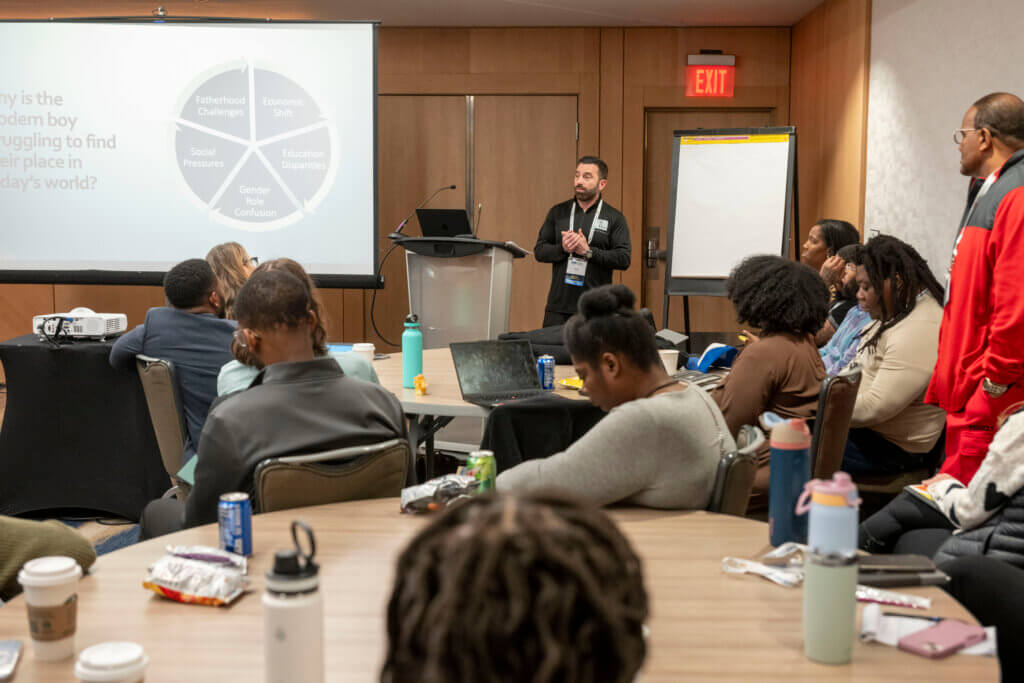
Our Connect | Focus | Grow training teaches adults in workplaces and other environments the skills they need to take on a mentoring role with a youth intern, younger employee, or young person in the community. This training builds America’s “army” of mentors but also trains young people themselves on how to maximize their mentoring experiences. Evaluations of the training have found that:
- 93% of adults felt the training helped them understand the mentor role.
- 86% of adults felt the training built their skills as a mentor in their organization.
- 77% of young people felt the training prepared them for the mentoring relationship.
- 74% of young people felt the training taught them skills for asking for, receiving, and maximizing the support of their mentor
- One study of this training for 1,500 young people entering the workforce found that 88% were retained in their jobs up to 90 days and 25% received some form of promotion or wage increase during their participation in the project.
- This training has also been used for mentoring in higher education contexts, with 91% of students indicating that the training prepared them for working effectively with their mentor and 96% of employee mentors saying they learned specific skills to support young people in higher education and the transition to careers.
Mobilizing a Nation of Mentors

We have the nation’s only dedicated database of mentoring providers, the Mentoring Connector, with the ability to facilitate inquiries of new prospective volunteers to get involved with a program in their community.
Over the past three years, we have connected 79,037 people to local mentoring opportunities through the Mentoring Connector.
Citations
1 DuBois, D. L., Holloway, B. E., Valentine, J. C., & Cooper, H. (2002). Effectiveness of mentoring programs for youth: A meta-analytic review. American Journal of Community Psychology, 30(2), 157–197.
2 DuBois, D. L., Portillo, N., Rhodes, J. E., Silverthorn, N., & Valentine, J. C. (2011). How effective are mentoring programs for youth? A systematic assessment of the evidence. Psychological Science in the Public Interest, 12(2), 57-91. http://dx.doi.org/10.1177/1529100611414806
3 Keller, T. E., Drew, A. L., Herrera, C., Clark-Shim, H., & Spencer, R. (2023). Do program practices matter for mentors?: How implementation of empirically supported program practices is associated with youth mentoring relationship quality. Journal of Community Psychology, 51(8), 3194–3215. https://doi.org/10.1002/jcop.23019
4 Kupersmidt J. B., Stump K. N., Stelter R. L., Rhodes J. E. (2016). Mentoring program practices as predictors of match longevity. Journal of Community Psychology., 45(5), 630–645. DOI: 10.1002/jcop.21883
5 McQuillin, S. D., Straight, G. G., & Saeki, E. (2015). Program support and value of training in mentors’ satisfaction and anticipated continuation of school-based mentoring relationships. Mentoring & Tutoring: Partnership in Learning, 23(2), 133-148. http://dx.doi.org/10.1080/13611267.2015.1047630
6 Drew, A.L., Keller, T.E., Spencer, R., & Herrera, C. (2020). Investigating mentor commitment in youth mentoring relationships: The role of perceived program practices. Journal of Community Psychology, 48, 2261–2276. https://doi.org/10.1002/jcop.22409
7 Anderson, A. (2022). National Mentoring Resource Center technical assistance evaluation, Summary. Boston, MA: MENTOR.
8 Keller, T. E., Spencer, R., Herrera, C., McBeath, B., Drew, A., & Clark-Shim, H. (2019). Research brief: Evaluation of the pilot implementation of the Quality Mentoring System.
9 Keller, T. E., & DuBois, D. L. (2021). Influence of program staff on quality of relationships in a community‐based youth mentoring program. Annals of the New York Academy of Sciences, 1483(1), 112-126. http://dx.doi.org/10.1111/nyas.14289